Cousins of your Cousins too
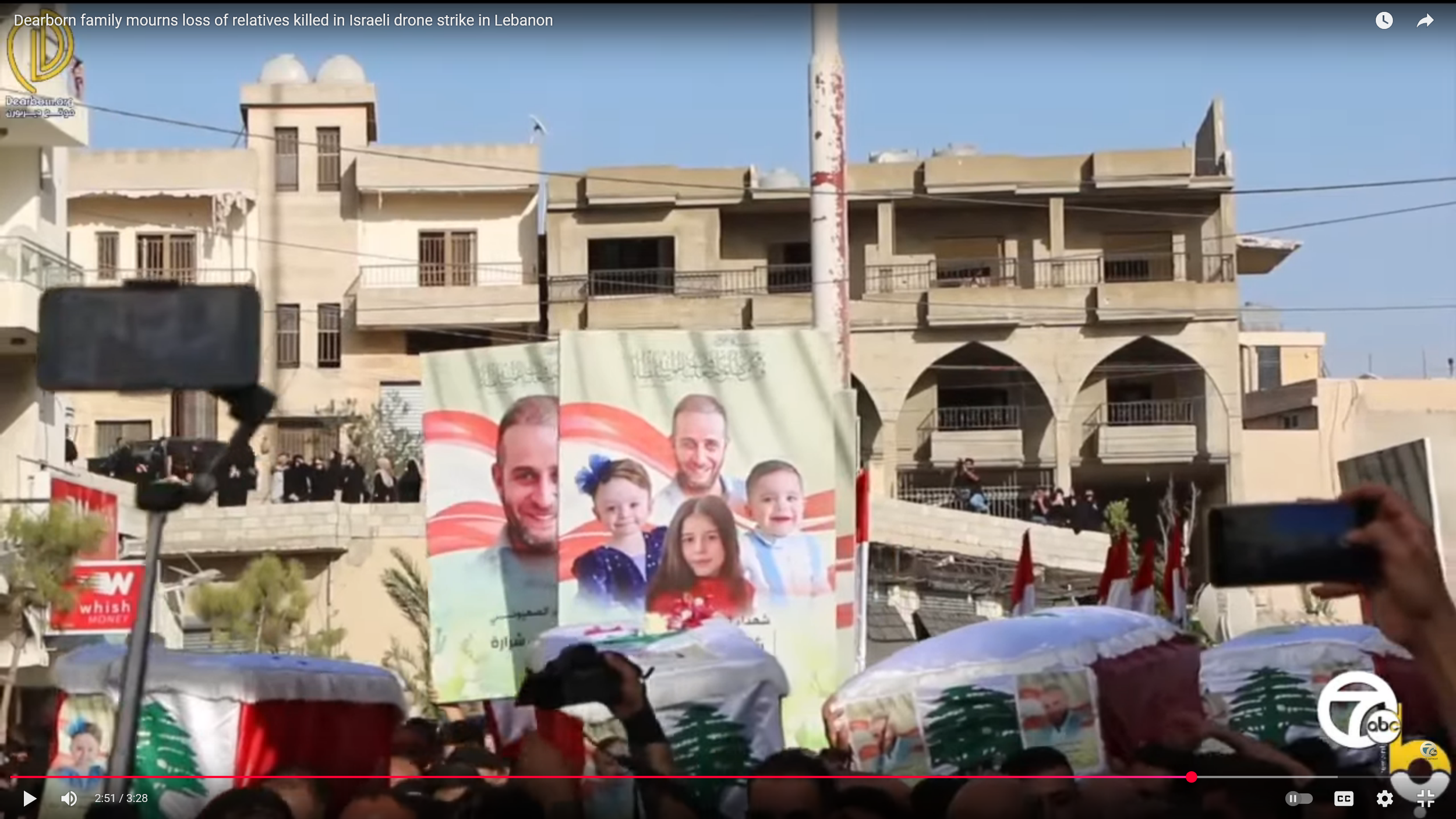
Screenshot from report by WXYZ-TV Detroit | Channel 7
Just another casualty, right? Add 3 children, or their dismembered body parts, and their dad to the thousands already buried under the rubble “in that part of the world.” Good news: their mother managed to survive the strike and attended their funeral on a stretcher. And their sister? Still fighting to survive. More “good news”? It was not some UFO or UAP (although there is some interesting news on that for another time), but an admittedly Israeli strike, supposedly targeting a “bad guy” on admittedly Lebanese soil despite a cessation of hostilities agreement. Hundreds, if not thousands, of such violations have been documented since November 2024. But it is all fine so long as we adopt one side’s narrative that they are targeting bad actors on another country’s territory and only hurting civilians on accident, or “unintentionally,” correct? Just take one side’s word on it because we (and/or they) are the most exceptionally fair judges in the history of court cases, right? Even when an international court of justice is warning such a side to prevent a genocide from occurring on (and/or because of) their watch in Gaza. Right?
Every single number is a story just like yours, dear reader. The Charara family had its own dreams, just like yours does. Shadi was striving to put bread on the table too. Celine would have gone to school on Monday too. The baby faces of Hadi and Silan would have brought a smile to the face of strangers walking by too. They could have been cousins of your cousins too. They could have been any one of our kids. Any one of our friends. Any one of us.
But this is not about the fragility of life so broadly speaking. I’ve held discussions for a course titled, “Why Do Bad Things Happen to Good People?” and it is much more than intellectually enriching for participants. It enables better coping with suffering, preventable or not. But when we realize that some suffering is preventable and that we have a responsibility to do something about it, the focus should and must shift. This is not a natural disaster for a cosmic wisdom. This is preventable, man-made suffering. It must be stopped by fellow man to prevent any further damage. The challenge we all face is to not become desensitized, not to become numb, not to become distracted. Does it have to shake us so close to home for us to wake up?
A close friend of mine, who I am tempted to call an enemy (very much a love-hate relationship ––long story), shared an intriguing anecdote with me that is relevant here. One of his students was practicing his Arabic skills and tested them out with a (playful) phrase that can be translated to mean, “Israel created Hezbollah.” I chuckled when I heard this story because it was a moment of witty reflection for me. The student was apparently referring to a level of analysis that does not perfectly fit the mold of narrative on either side of conflict. Neither does Hezbollah consider Israel its main inspiration nor does the Israeli government take credit for forming cells of resistance to its occupation of Lebanese soil, for instance. Yet, it is this sort of thought twister that can potentially break the cycle of tit-for-tat in the media, in the annals of history, and, indeed, on the battlefield. From this angle of analysis, the point is not the name of the group(s), their articles of incorporation, or official blacklist designations, for that matter. The point is, rather, the underlying function, causes, and how to address the substantive issues at stake with appropriate sensitivity. In our privileged positions as Americans, or merely as humans who are not being bombed at the moment, what can we do about all this?
The words of my Ph.D. advisor at Columbia University (2016-2022), the late Professor Emeritus Brinkley Messick (d. 14 August 2025), resonate still. As he once wrote, “I completed this study in a time of war in and upon Yemen, a time of human suffering and devastation. I am ashamed that the United States has been a facilitator of aggression rather than a staunch advocate of peace.” (Brinkley Messick, Sharīʿa Scripts : A Historical Anthropology (Columbia University Press, 2018), 404). Had he been alive and well, writing about the aggressions over the past several months, I am certain that Dr. Brink would have also meant Palestine, Gaza, Lebanon, and anywhere else where unnecessary suffering is being enabled by our government’s decision-makers. Brink was born in Dayton, Ohio in 1946 and served in the Peace Corps long before he specialized in the secular academic study of Islamic cultures, bridging the disciplines of Anthropology, History, and Middle Eastern, South Asian and African Studies. Across the spectrum of our government agencies, grassroots movements, social media platforms, and community centers, can we rise to the challenge of being the best version of ourselves? Each day a bit better than the last? Holding ourselves accountable?
In the face of double standards or empty slogans that do too little too late, if anything at all, for the destitute, disenfranchised, and the meek of the Earth, I recall the hints of a traditional scholar-sage who also departed us recently. He was one of the two primary advisors who oversaw my studies in the Ḥawza learning community of Najaf, Iraq (2010-2014). In 2010, I had travelled to the age-old shrine-town of Najaf to explore questions of epistemology, philosophy of science, and spirituality, alongside other traditional knowledge systems of the Middle East. Simultaneously as part of my personal and intellectual journeys, I was looking for a program on more “mystical ways of knowing.” He knew what I meant ––his great grandfather had reportedly written a book on it! His words were brief but clear enough: That is not how we do things here ––the focus is on what you observe (and absorb) in practice. The sagely teaching-scholar, whose ancestral legacy of traditional scholarship and spirituality was only matched by his family’s recent roles in the scholarly, political, social and spiritual history of post-Saddam Iraq, was the dearly departed professor of advanced Ḥawza studies, the venerable Sayyid Muḥammad ʿAlī Baḥr al-ʿUlūm (d. 23 August 2025).
Claiming to avoid civilian casualties is easy, but it was likely already too difficult to swallow the very first time, let alone after decades of supposedly accidental or “unintentional” massacres. Imagine it is your baby first. If that does not move your conscience, then imagine it is you. If that does not move you to your senses, then beware that healthy members of humanity will not stand idly by. To talk the talk of a sage, much like saying something politically correct, might very well be teachable. Maybe even impersonated by artificial intelligence, sooner or later. But to sense the inner peace of a sage, the contagious tranquility of presence without anxiety, that is something else. To speak of patience and self-restraint is one thing, but to refrain from pulling the trigger of treachery, or the fancy button of butchery, is another thing altogether.
Luckily for the criminal-in-a-suit or criminal-to-be, the moral duty at hand is much more feasible than becoming a true saint: Just stop the massacre. Stop the starvation. Stop the genocide (or whatever name you choose to call it ––just stop it). Show good will. Show that you are not bent on maintaining conflict. Show that you are better than to prioritize might over what is right. If you are too weak, then step aside and let those who are capable minimize the damage. If you are so tough, then show that you are on the higher ground in terms of your morality. May the memory of the innocent martyrs haunt the criminals until their crimes are accounted for. May their blessed souls rest in peace.
Intro to this Blog
I have been considering the pros and cons of focusing this blog on a particular theme or intended readership. With all the merits of specialization, I submit that my academic specialization has me niched enough for the rest of my time on Earth, and that I will be looking forward to this blog as a more diversified avenue of expression. It will still be me, just not always the PhD dissertation mode of me. For that, I beg your pardon, you will have to wait for the occasional academic study I announce here, or read parts of my dissertation (hint to fellow academics, in particular). So you can expect this blog to shed light on the more far-reaching implications of my work as an academic, tailored to a diverse and broad readership, weighing in on current events while also contextualizing and drawing lessons from history. Without further ado, welcome to Ali Moughania’s blog!