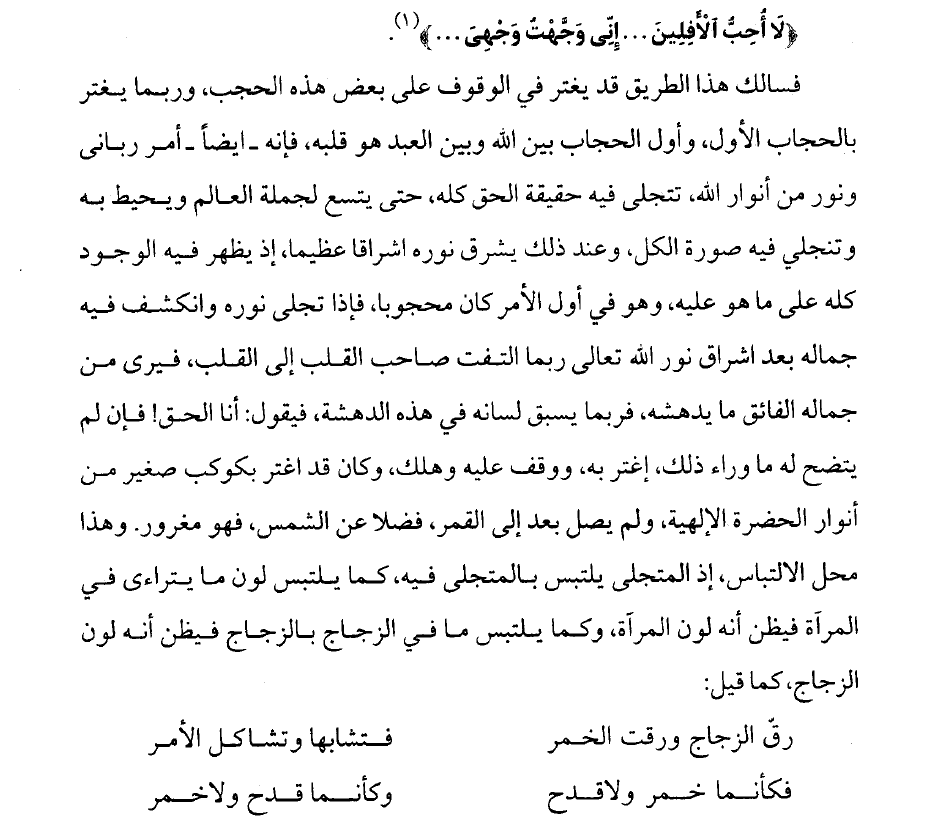
Excerpt from al-Narāqī's Jāmiʿ al-Saʿādāt, v. 2, p. 216. Part of this excerpt reads, “…similar to how the color of the image in the mirror may become confused with the mirror, such that one thinks it is the color of the mirror…”
In a recent talk, I contextualized some of the interventions by Mawlā Mahdī al-Narāqī (d. 1209/1794) in the history of ethics and mysticism reform. (Note: This is a trend of mysticism within Shia Muslim practice endorsed by the likes of the widely renowned mystic and Islamic legal authority, the late Shaykh Muhammad Taqi Bahjat (d. 2009). Other trends of mystical practice within Shia Islam include those inspired by outspoken proponents of passionate commemoration rituals, such as the late Shaykh Hossein Wahid Khorasani (d. 2026), another leading Twelver Shia legal authority, especially renowned among Hawza teachers and students, who passed away a few days ago. The latter trend includes those with a range of sensitivity toward the labels “Sufism” and/or “ʿIrfān” but, for the most part, representatives of this trend do not publicly condemn Twelver Shia legal-minded-mystics such as al-Narāqī.).
Al-Narāqī’s ethics work of mystical appeal, Jāmiʿ al-Saʿādāt, resonated with earlier works on applied ethics and mysticism without being received as merely an abridgement, recension of, or a marginal commentary on, such publications. Remarkably, al-Narāqī continued to pursue his scholarly work in the midst of much personal and communal turmoil, including natural disasters, displacement, widespread illness, and the loss of loved ones. I argued that when al-Narāqī was discussing how to systematically differentiate interior promptings/suggestions (khawāṭir), he was not merely presenting a way to reform or renew mystical practice and interpretation but also more subjective approaches to knowledge debates in his day.
While I emphasized the value of taking a descriptive and analytical approach to this history, I also highlighted that doing so should help expand our imagination when we return to confront philosophical and ethical challenges of our day. One may begin to see the potential in this by getting passed the superficial barrier of the words, something I gestured toward in a previous blog post related to AI. For instance, this includes looking past the notion of an “angelic force” to see a functional analogue called, “aligned AI,” and past a “demonic force” to see “misaligned AI.”
As a concluding remark on the potential rise of superintelligent AI, I noted that if a human is still around to witness it then that human will also still have something he or she has had all along ––the question, the prompt, like the prayer and supplication (duʿāʾ) to God. Generally: what to ask is a choice; how to ask is a choice; who to ask is a choice; why to ask is a choice; whether to ask is a choice; but having a decision to make is a fact beyond choice, whether Superintelligence arises or not.
More on the context of this talk:
I recently participated in a panel on reformed mysticism, or Sufi renewal, in the modern Islamic world. The discussion was held by Columbia University’s Sakip Sabanci Center for Turkish Studies, which supports research on various aspects of Ottoman history spanning its vast geographical range and internal diversity. Some may not realize that the Ottoman Empire ruled for hundreds of years over much of the Middle East, Southeast Europe, and North Africa, not merely Anatolia. I had not previously framed my work as directly part of Turkish studies, but with the aforementioned in mind, the MESAAS and Islamic Studies overlap is clear. Granted, my previous work has traced roots of paradigmatic criteria for forms and features of 'leadership' in Islamic thought through the 13th century CE, which provides a critical background for most subsequent Islamic intellectual history until the present day. But it is, arguably, my ongoing research on the Hawza community’s lived experience and history that fits squarely within this scope through and beyond Ottoman (Turkish) and, for that matter, Safavid (Iranian) times. The term “Hawza” in this context refers to the network of Twelver Shia Muslim seminary communities, such as those in Najaf and Karbala of (the once Ottoman) Iraq, and Qom and Isfahan of (the once Safavid) Iran. Writing a book on the Najaf Hawza at the cusp of superintelligence, and currently finishing a related article on al-Mawlā Mahdī al-Narāqī and his reformed mysticism, I welcomed the invitation to share some of my findings.