Why Don’t They Just “Surrender”?
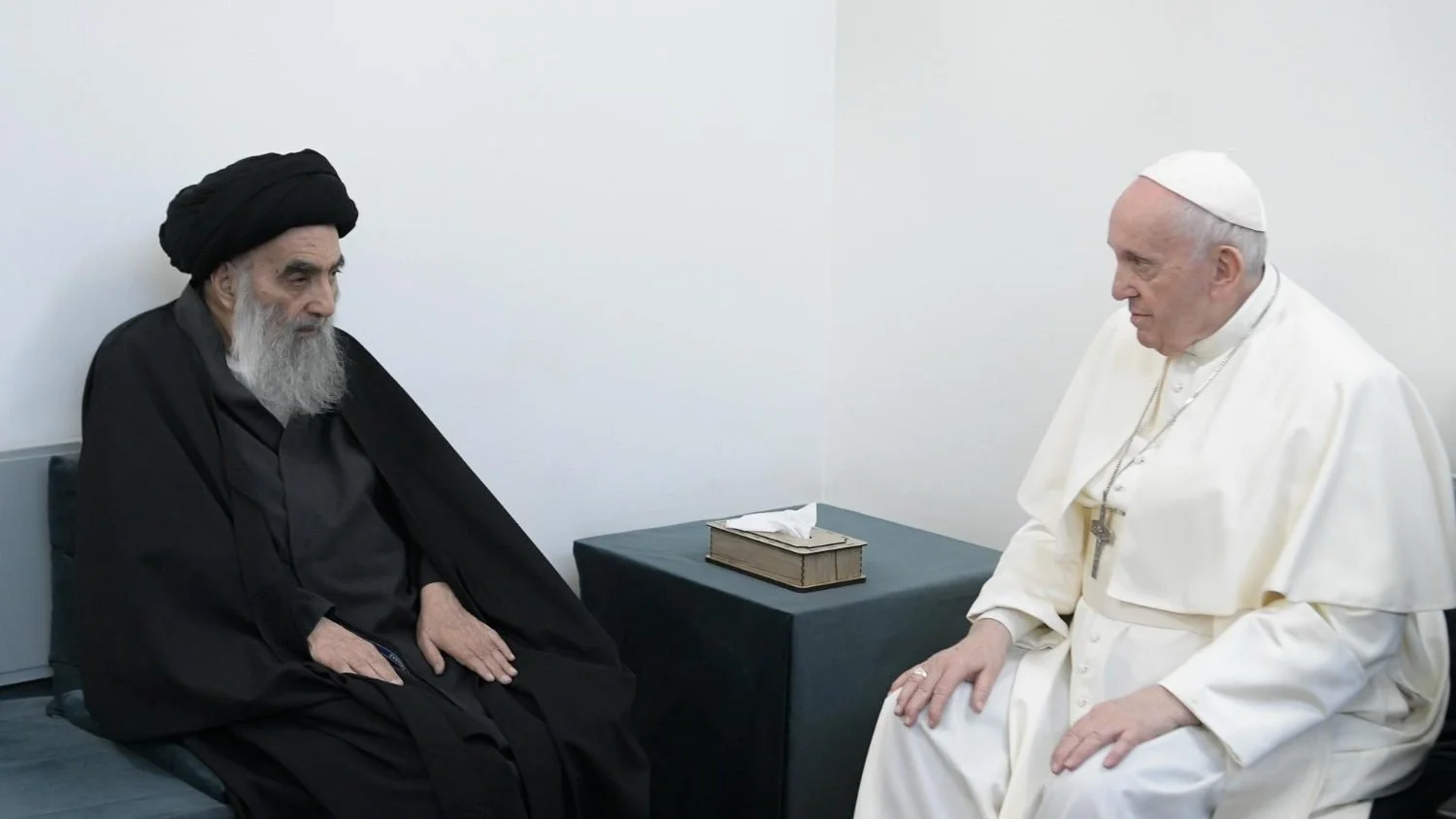
Pope Francis and the Grand Ayatollah Sayyid Ali Al-Husayni Al-Sistani in Iraq in March 2021 (photo from https://www.vaticannews.va/en/pope/news/2023-03/pope-francis-ayatollah-al-sistani-message-anniversary-visit-iraq.html)
This post should be of relevance to both decision-making public officials as well as members of the general public who are concerned about the safety of American service personnel. I usually would not have weighed in so soon after an earlier post, but the gravity of what is at stake as well as the relative absence of this perspective in the most widely accessible media coverage (as far as I can tell) pushes me to make an exception. The fact that the Senate and the House both voted (for the most part) along party lines when there was an opportunity to express bipartisan objection (or at least reservation) regarding needlessly putting American armed forces in harm’s way is another cause for urgency. As a footnote, although such votes arguably do not precisely represent the electorate that brought them to power, those members of congress who have failed to live up to their moral and civic duties are becoming complicit to the extent that they are unexcused in enabling the crimes being committed (try justifying that to the American people and the international community though ––come November, we remember). Back to the point of this post: if the Iranian military has been so severely damaged by American tax-payer military might, why don’t they just “unconditionally surrender” already, as the current President has been hoping? Is this a matter of time? Or is there a deeper analysis of what is going on here? I specialize in understanding the ideological foundations for the religiously-trained personnel in question ––it is more complicated than you might assume.
Of course, specializing in Middle Eastern Studies, particularly in the Intellectual History of its diverse Muslim or Islamic populations, does not automatically mean a specialization in the ideology of the Islamic revolutionary guards, for instance. But there is such a significant overlap in what I will be referring to justifying the extended specialization area. In other words, this applies to various iterations of Muslim thought, not merely in the iteration specific to the Iranian Islamic revolutionary guards. For a more detailed discussion, a specialized session or course would be in order. But as an executive summary of sorts, consider the following. Muslim thought, including Twelver Shia Muslim thought, includes a number of historical precedents that have been taken as authorizing different forms of expressing dissent, depending on the circumstances. These are thought to have biblical or more innately human origins, have been documented in the holy book (and miracle claim) of Islam, the Quran, as well as in reports of early Islamic history. But traditional scholars of Islamic thought disagree in the synthesis of these different cases, in the resulting emphases, and, perhaps most crucially, in the transparency of applying them to changing circumstances.
For example, the historical precedent of concealing one’s faith when prevailing circumstances are unsafe, only expressing one’s views with careful discretion, exists in Quranic references to “a man of faith from the House of Pharaoh who was concealing his faith,” (40:28), as well as the Prophet Muhammad’s companion Ammar ibn Yasir (16:106). This sort of a precedent would not only justify an avoidance of military confrontation but even of expressing dissenting views in some cases. The Prophet Muhammad reportedly avoided the use of physical force for several years in the beginning of his mission, despite being personally harassed and disrespected (traditionally understood to be part of his mission in demonstrating patience and the higher moral ground unless death were to be deemed inevitable). In this period, he was, however, vocal about his views, delivering a message that he said was in line with that of biblical prophets sent to the Israelites, and even Jesus Christ, but he claimed that those earlier messengers had been misrepresented over time, regardless of intentions (thus explaining some disagreements with Jews and Christians of his time and subsequently). It is said that he only left his hometown, Mecca, under the threat of assassination, after his uncle and influential protector from hostile clansmen had passed away. Moreover, the Prophet Muhammad’s grandson, known to Twelver Shia Muslims as the second Imam, Hasan, reportedly accepted a cessation of hostilities agreement with Muawiya ibn Abi Sufyan, not because he trusted his judgement or honoring of the potential agreement, but because of a multidimensional calculus of long-term community interests coupled with the unreliability of his own soldiers at the time.
On the other hand, defensive measures with a spectrum of passive to more proactive expressions, similarly have historical precedents. For instance, the biblical Prophet Moses is described in the Quran as having come to the aid of a fellow in faith, using physical force (28:15). The Prophet Muhammad and his followers were given permission to fight in self-defense due to their forced migration from their hometown and/or to deter further harm being done to their freedom of public religious expression (22:39). They were commanded to fight, despite hating it, to deter aggressors from seeking to annihilate them (e.g. 2:194; 2:216; 4:84). Perhaps most crucial for the purpose of deterrence, they were ordered to prepare, proactively, whatever means of force that might be effective in order to deter “God’s enemy and your enemy” (8:60), leaning toward peace when possible, while being vigilant of potential deceit. The Imam Ali, first Imam to Twelver Shia Muslims, and fourth caliph to Sunni Muslims, took up arms in order to defend his administration against civil unrest after having been acknowledged as caliph by the masses (in addition to Prophetic appointment, according to Shia Muslims). In Shia tradition, he is said to have opted for patience and minimizing damage to the nascent Muslim community up until then despite being the rightful (immediate) successor to the Prophet Muhammad. The Prophet’s grandson, known to Twelver Shia Muslims as the third Imam, Husayn, was reportedly forced into a standoff with forces under the command of Muawiya’s son Yazid, in which he was given one of two options: surrender in disgrace, or fight to the death while being vastly outnumbered ––i.e. face guaranteed death; he and many loyal companions alongside him chose the latter, not to “die” but to be martyred in the way of God.
Islamic history beyond those early precedents is filled with examples of prominent Muslim figures who chose the path of one, the other, or both, precedents, depending on their outlook and/or circumstances. For instance, according to Twelver Shia Muslims, their Divinely appointed Imams after Imam Husayn generally avoided direct confrontation with ruling authorities. They were often accused of plotting against the authorities and their sudden deaths have been believed to be caused by poisoning assassinations, but with the exception of their 12th and awaited Imam (i.e. the Mahdi) who is anticipated to potentially take up armed struggle for world justice, the other post-Husayn Imams did not directly take up arms against Muslim rulers. That being said, it is suspected that they indirectly endorsed or at least tolerated some of those who did take up arms against their oppressors, such as Zayd ibn Ali ibn Husayn, who is arguably respected by Twelver Shia Muslims but not viewed as an Imam in the same sense as the 12 Divinely appointed Imams whom they hold in exceptional esteem. The way such history is read is important to consider when assessing how pragmatic it would be to entertain forcing an organized, ideologically-oriented, Muslim group into “unconditional surrender.” Consider the following synthesis attempts as thought experiments.
Synthesis A: The Last Stand Model
Some Muslim scholars might argue that the position taken up by Imam Husayn, for example, is a model to be followed whenever possible. This was not suicide, but well-calculated martyrdom, meant to rejuvenate the community’s spirit in the long-run, deterring enemies in the process. His brother, the Imam Hasan, would have done the same had he had even the few loyal supporters that the Imam Husayn had. Subsequent exemplars of Muslim leadership who fell short of this standard, similarly, only did so because they did not have the quality of supporters who would make the sacrifice meaningful as a test of faith. That is, they had to prioritize training such followers instead of merely sacrificing themselves before passing on. They might superficially acknowledge a tyrant, or desist from resisting arrest or the like, but this should be understood as a temporary regrouping, only until the baton can be passed on for the ultimate sacrifice, not a “surrender” of moral ground. Such thought arguably yields a perpetual posture of resistance, only hidden at times, but forever attempting to surface when possible. So long as a loyal group of such supporters exist, the resistance can potentially continue perpetually with no “surrender,” even if they are all killed ––justified by going down in history to be remembered as “martyrs.”
Synthesis B: The Strategic Discretion Model
Other Muslim scholars might argue that the path of martyrdom chosen by Imam Husayn, for example, is only a model to be followed in exceptional circumstances, perhaps only justified by the assessment of someone as ideal as Husayn himself. The exception of the Imam Husayn exists not to be encouraged as a standard but to reinforce the actual standard indirectly, which is to navigate life with careful discretion (instead of sacrificial confrontation). In this synthesis, what may be perceived as a quietist approach is the general posture expected of a Muslim. It is not “surrender” to evil per se, but it is wise discretion for the purpose of a long-term strategy. The practice of the post-Husayn Twelver Shia Muslim Imams would appear to support this general posture. A Muslim with this outlook would think of the strategic decision as a surrender to God’s wisdom, not to the tyrant, and it is definitely possible to occur in the face of overwhelming tyrannical force. Sure, this still has limits, which are discussed in Islamic law. If the survival of ultimate religious truths and/or the Islamic community’s integrity are at stake, for instance, self-defense is not merely permissible but mandatory. That being said, at times the duty of such defense, to the extent of its utility, might already be being carried out sufficiently by others, in which case not everyone would necessarily be in the defensive posture at all levels. Regardless, in their capacity as Islamic judges, qualified religious authorities could still issue judgements calling for the arrest and/or punishment of those committing crimes against innocents, and these orders would generally be considered binding on all Muslims. Hence, even when an individual may otherwise want to surrender, it could become binding upon him to fight in order to implement that judgment in some cases.
Synthesis C: “Black Box” of Epistemic Reservation (meta-framework)
Another group of Muslim scholars may acknowledge the strengths of the aforementioned syntheses depending on the circumstances, but refrain from accounting for their own synthesis in a robust manner. There is arguably more to this than merely maintaining a degree of ambiguity for greater interests that may be at stake. In some cases, the ambiguity may be at the level of the synthesis itself, not merely the presentation of it. How so? Depending on the epistemic assumptions of the scholar in question, mystical experiences may play a role in arriving at the certainty threshold required for his assessment of exceptions to the default posture. For those scholars that have a categorical issue with appealing to mystical experiences as evidence, they still might admit a verified encounter with the 12th Imam (or someone on his behalf) to serve the same purpose. Predicting what such scholars and their loyal followers would do when confronted with threats of overwhelming force is not straightforward. It is very possible that they might default to a position that mimics one of the A or B syntheses above in terms of external actions, but have a different internal justification for it. Why does this difference matter? Because in cases with high stakes the “black box” ambiguity they exhibit may be one that is also part of their synthesis itself. A decision-maker who thinks it is worthwhile to “call their bluff,” if you will, may indeed be leaning in to the type of risky scenario creating the desperation characteristic of what may be subjectively experienced as a “mystical experience” or that which functions in a similar fashion. So, would such adherents be more likely to “unconditionally surrender” if they remain true to their Islamic thought commitments? If mystical experiences (or trusted claims to have experienced them or the like) can be artificially engendered, then the conditions for giving the ultimate sacrifice may very well be more likely than “surrender.”
Which synthesis do the Iranian armed forces adopt? Well, the answer is not so straight forward. There is a fairly common culture among Shia Muslims today that would seem to be driven by Synthesis A. Yet, technically, this may be a conflation of driving syntheses. It would actually depend on the view adopted by the Guardian Jurist (al-wali al-faqih) and/or the Religious Authority (marjiʿ) of each individual service member. “Revolutionaries” would seem to be justifiably stereotyped as adopting Synthesis A, but assessing any religious authority’s views in extreme case scenarios can be tricky. For even when religious authorities write books on these matters, they do not necessarily spell out all variables that determine decisions in the final analysis. If I had to guess, I would estimate that most (living) Twelver Shia Muslim religious authorities, whether affiliated with Iran’s government or not, can be understood as adopting some version of Synthesis C.
The above syntheses are being presented in consideration of the Islamic thought dimension to a given ideology (e.g. in this case, the Iranian Revolutionary Guard). If national or cultural identity and a sense of honor related to sacrifice in defense of one’s homeland are added into the mix, then each assessment betting against “unconditional surrender” is even more convincing.
Call to action: Stop this war immediately before things get any worse, and study, study, study. Not to mention that this is a very costly distraction from the AI safety and policy decisions that are needed to safeguard the future of humanity and human dignity.
Intro to this Blog
I have been considering the pros and cons of focusing this blog on a particular theme or intended readership. With all the merits of specialization, I submit that my academic specialization has me niched enough for the rest of my time on Earth, and that I will be looking forward to this blog as a more diversified avenue of expression. It will still be me, just not always the PhD dissertation mode of me. For that, I beg your pardon, you will have to wait for the occasional academic study I announce here, or read parts of my dissertation (hint to fellow academics, in particular). So you can expect this blog to shed light on the more far-reaching implications of my work as an academic, tailored to a diverse and broad readership, weighing in on current events while also contextualizing and drawing lessons from history. Without further ado, welcome to Ali Moughania’s blog!